Choosing a piece of jewelry starts with understanding what it is: a visual composition element that alters the perceived proportions of a silhouette, directs the gaze, and conveys a stylistic intention. Making the right choice of jewelry for everyday wear relies on three concrete parameters: the material of the jewelry, its relative size in relation to the area of the body where it is placed, and its coherence with the style of clothing worn.
Jewelry Materials: How Composition Affects Wear
Before discussing style, the question of material determines comfort, durability, and compatibility with the skin. Jewelry worn every day is subjected to sweat, friction, and contact with water or cosmetic products.
Stainless steel resists oxidation and maintains its shine without special maintenance. It is a suitable choice for bracelets and rings worn continuously. Silver 925, being more malleable, tarnishes over time and requires regular cleaning to keep its brilliance.
For gold jewelry, the mention “gold plated” is framed by a minimum thickness of coating in France. Below this threshold, the jewelry cannot legally bear this designation. This distinction helps compare two pieces that appear identical but are of different quality. A complete catalog allows for comparing available materials, such as the one offered on https://www.tous-les-bijoux.fr/, which brings together different ranges.
In the case of sensitive skin, European regulations limit the release of nickel for jewelry in prolonged contact with the skin. Earring posts intended for pierced ears are subject to an even stricter limit. Checking the seller’s information on composition avoids unpleasant skin reactions after a few hours of wear.
Proportions and Morphology: Adapting Jewelry Size to Silhouette
A piece of jewelry does not serve the same visual function depending on where it is placed. The basic principle is summed up in one rule: a piece of jewelry draws the eye to the area where it is located. Choosing the size and shape of a piece is about deciding where the attention is directed.
Earrings and Face Shape
Long, thin earrings visually elongate a round face. Conversely, wide hoops or studs balance a narrow face by adding width at the cheekbone level.
For everyday wear, studs remain the most versatile format. They adapt to most outfits without creating a mismatch between a casual style and an overly formal accessory.
Necklaces and Necklines
The length of the necklace interacts with the neckline of the garment. A choker works with a V-neck or boat neckline, while a long necklace is worn over a high collar or a solid-colored sweater to break the verticality of the fabric.
Wearing a necklace of the same length as the neckline creates a visual redundancy that flattens the silhouette. The contrast between the two lines (that of the jewelry and that of the garment) produces a more structured result.
Bracelets and Rings for Everyday
A thin bracelet suits slender wrists, while a thick bangle adds presence to a wider wrist. For rings, the size of the setting should remain proportional to the length of the fingers: an oversized cocktail ring on short fingers visually shortens the hand.
Clothing Style: Matching Jewelry and Outfit Without Overloading
The style of the outfit determines the style of the jewelry. Mixing codes works in fashion but requires skill. In practice, three guidelines are sufficient to avoid missteps.
- An outfit with busy patterns (flowers, checks, graphic prints) calls for discreet jewelry in solid metal, without stones or complex pendants, to avoid overwhelming the eye.
- A monochrome and understated outfit (raw jeans, white shirt, black dress) can support larger or textured pieces that become the focal point of the silhouette.
- A casual everyday look gains coherence with materials like stainless steel or brushed silver, which are less formal than polished gold.
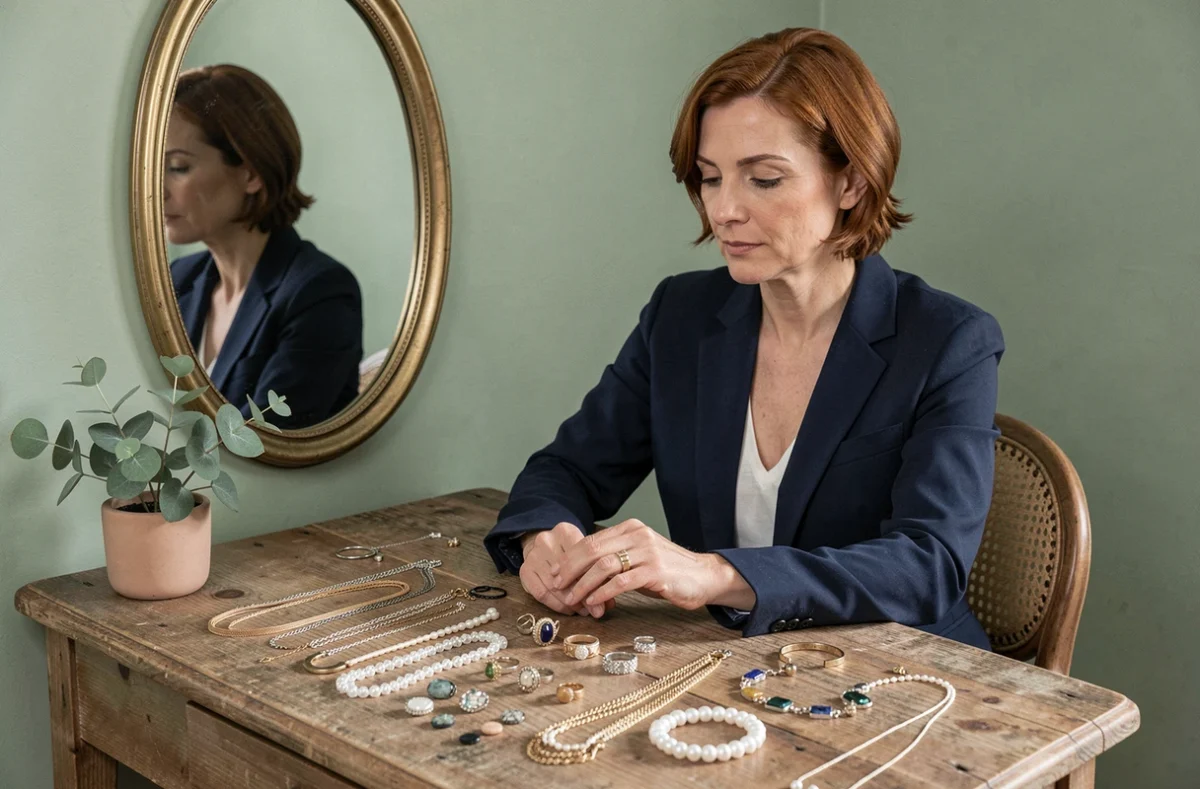
A common pitfall is to multiply strong pieces in the same area. Two layered necklaces, dangling earrings, and a wide bracelet create an accumulation that disperses attention. Layering works when the pieces share a common thread: same metal, same chain thickness, or same color palette.

Mixing Metals and Visual Coherence of Jewelry
The question of mixing gold and silver in the same outfit often arises. No absolute rule prohibits it, but visual coherence depends on how the metals are distributed.
Two approaches yield readable results:
- Distributing each metal by body area: silver on top (earrings, necklace) and gold on the bottom (bracelets, rings), or vice versa. This separation avoids a patchwork effect.
- Choosing two-tone pieces that incorporate both metals into a single piece of jewelry. This creates a visual bridge that legitimizes the coexistence of tones throughout the silhouette.
- Using a dominant metal (present on at least two pieces) and an accent metal (on a single piece), which hierarchizes the composition.
Jewelry made of brushed stainless steel presents a neutral tone, between shiny silver and matte gray, which easily pairs with both gold and polished silver.
Hallmarks and Legal Mentions: Check Before Buying
The absence of a hallmark on a small piece of jewelry does not prove that it is not made of precious metal. Some pieces below the regulatory weight thresholds may be exempt from the guarantee hallmark. Asking the seller for documented information about the metal and its title remains more reliable than relying solely on visible markings.
Checking the declared composition protects both the skin and the investment. A piece of jewelry sold as “silver” without specifying the title (925, 950) or “gold plated” without indicating thickness deserves an additional question before purchase. These details, often missing from online descriptions, make the difference between jewelry that lasts and jewelry that tarnishes within weeks.
Ultimately, the choice of everyday jewelry rests on a balance between three criteria: a material suited to one’s lifestyle, a proportion coherent with one’s morphology, and a style that complements the outfit rather than contradicting it. Once integrated, these three guidelines simplify every decision in front of the jewelry drawer.