
Plantar fasciitis imposes specific biomechanical constraints on the choice of open shoes. Clinically, the sandal used during the remission phase must meet three functional criteria: longitudinal rigidity of the footbed, structured heel counter, and compatibility with a custom orthotic. Billowy and Birkenstock sandals do not address these criteria in the same way.
Longitudinal rigidity and heel counter: what really differentiates the two footbeds
The torsional rigidity of the sole is at least as critical a parameter as the level of cushioning. A footbed that twists easily under load does not control mid-tarsal pronation, which increases tension on the fascia. In this regard, the cork-latex footbed of Birkenstock offers significantly superior torsional resistance compared to most soft EVA or polyurethane soles of the Billowy models.
The heel counter is the other distinguishing element. At Birkenstock, the molded heel cup in cork wraps around the calcaneus for several centimeters in height. This structure limits the lateral movement of the fat pad in the heel, which acts as a natural shock absorber. On the Billowy, the heel counter exists but is less deep, which is suitable for a healthy foot but proves insufficient when the fascia is already inflamed.
We recommend testing the rigidity by bending the sandal in half lengthwise: if it bends easily in the middle, it does not provide enough protection for the midfoot. This simple test eliminates the majority of sandals with soft soles.
To complement this analysis, a review of the Billowy or Birkenstock brand details the construction differences between the two ranges.
Usage window in plantar fasciitis: when to wear an open sandal
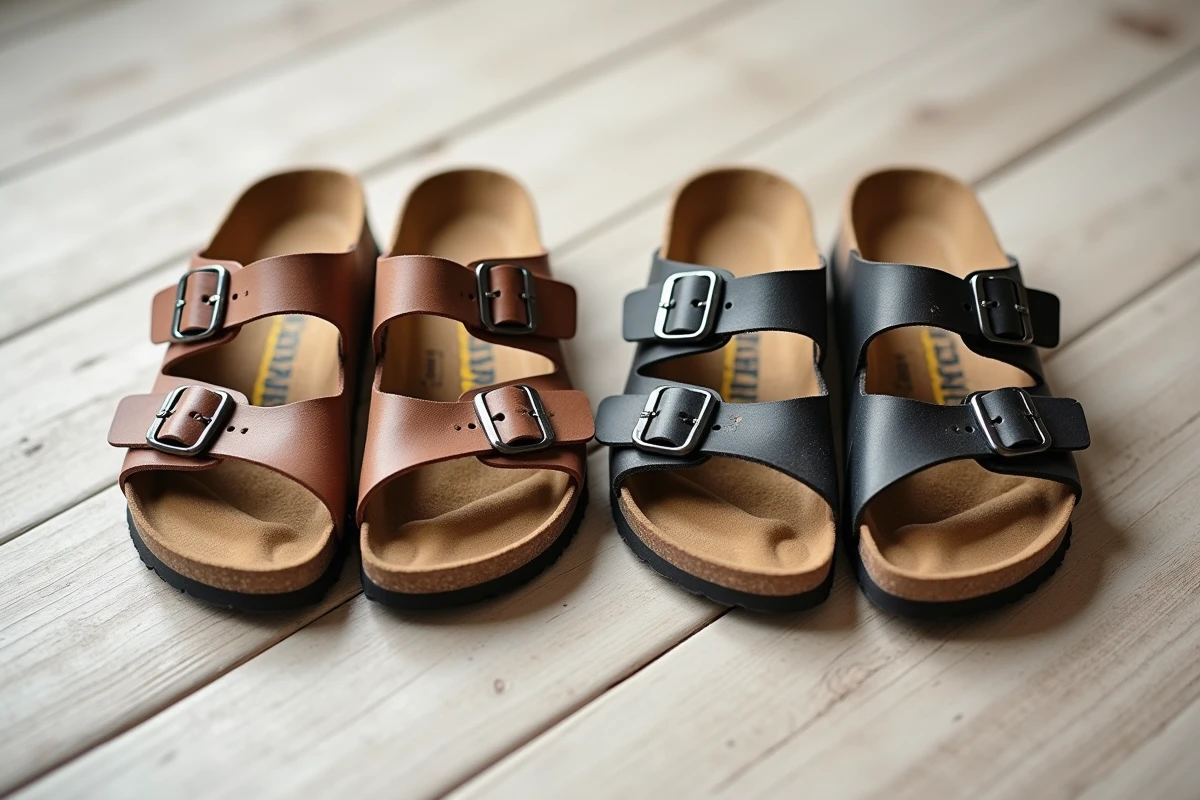
Sandals, even well-designed ones, do not replace a closed shoe with a rocker sole during the acute phase of fasciitis. Birkenstock and Billowy are reserved for remission phases or limited domestic use. Ignoring this distinction leads to frequent relapses.
In the acute phase, the pain of the first morning step indicates active inflammation of the calcaneal enthesis. The foot needs overall support that only a closed, rigid shoe with sufficient drop can provide. The sandal comes into play when the morning pain has disappeared for several weeks.
In the remission phase, wearing a Birkenstock at home offers a concrete advantage over walking barefoot on hard surfaces. The footbed absorbs part of the shock wave at the heel while maintaining the longitudinal arch. The Billowy fulfill this role in a less structured manner, but their lightness and flexibility suit those who find Birkenstock cork too firm at the beginning of remission.
Compatibility with custom orthotics
This is a criterion that public comparisons almost systematically overlook. Many patients with plantar fasciitis have an orthotic prescribed by a podiatrist. The question is not only the comfort of the sandal but its ability to accommodate an orthopedic insole.
Some Birkenstock models with removable footbeds (Professional range and a few references with removable soles) accept a thin orthotic. The podiatrist may sometimes need to slightly grind the cork to adjust the interior volume or prescribe a shorter and thinner orthotic than that used in a closed shoe. This compromise works, but it requires a consultation.
On the Billowy, the insole is generally glued and non-removable. Adding an orthotic on top changes the height of the foot in the sandal, destabilizing the strap and reducing support. In this scenario, the benefit of the orthotic is partially negated by the loss of foot stabilization.
- Birkenstock with removable sole: compatible with thin orthotic after podiatric adjustment, heel counter support preserved.
- Birkenstock with fixed sole: no possibility for orthotic, but the original footbed already provides adequate arch support for remission without orthotic.
- Billowy with glued sole: orthotic not recommended on top, interior volume is too low and strap support deteriorates.
Foot profiles and sandal choice in practice

The choice between Billowy and Birkenstock also depends on the morphological profile of the foot and the age of the patient. A foot with mid-tarsal osteoarthritis or reduced subtalar mobility tolerates soft cushioning better than firm cork. In this case, Billowy may be preferred despite their lower structural rigidity.
Conversely, a hyper-pronated foot with recurrent fasciitis needs the mechanical control that only a rigid footbed can provide. The Birkenstock cork, which partially molds to the arch with use, eventually conforms to the arch without losing its torsional resistance. This mechanical behavior does not exist in standard EVA foam.
Size also plays a role. Birkenstock offers a sizing system in length and width (Regular / Narrow) that allows for lateral adjustment. Billowy uses a classic fit without width options, which limits adaptation for wide feet or associated bunions.
- Pronated foot with recurrent fasciitis: classic cork Birkenstock footbed, two or three strap model.
- Arthritic foot or elderly person with joint stiffness: Billowy with soft sole, short domestic use.
- Patient with prescribed orthotic: Birkenstock with removable sole, after podiatric validation.
- Looking for lightweight summer wear without active pathology: Billowy, whose leather and flexibility suit relaxed daily use.
Price also factors into the equation. Billowy are positioned at a lower price point, which may seem attractive. But a cheaper sandal that triggers inflammation costs more than a suitable sandal worn at the right time in the care pathway.
The final choice depends on the phase of the pathology, the morphology of the foot, and the presence or absence of an orthotic. No open sandal replaces a closed shoe in the acute phase. In remission, Birkenstock takes the technical advantage in rigidity and orthotic compatibility, while Billowy remains an acceptable option for feet that cannot tolerate a firm footbed.